Description of a Customer Journey
To be able to benefit, at the end of your customer journey representative work, from the analysis facilities offered by HOPEX Customer Journey, we recommend you follow the methodological steps shown in the diagram below.
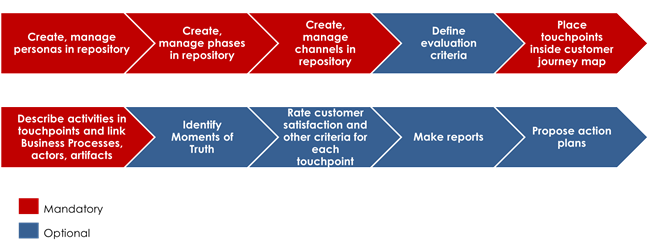
Defining persona and business lines
This consists of preparatory work identifying the different types of customers according to their needs and what they bring to the company.
The purpose of this phase is to identify the persona as well as the business lines.
 A persona corresponds to a customer segment targeted by the experience of the client journey. The resources implemented to give customers the ability to interact with the enterprise and its environment, to acquire the expected results, are supported by the interaction channels.A business line is a high level classification of main enterprise activities. It corresponds for example to major product segments or to distribution channels. It enables classification of enterprise processes, organizational units or applications that serve a specific product and/or specific market.
Using our example of the travel agency, we are interested in the young adult segment. The business line preferred for this population is "Sports holidays".
You must begin by assessing the customer expectations for each persona.
A customer expectation is an enterprise result expected by the persona at the end of the journey.For example, a population of young adults can expect, with a sports holiday, a wide range of activities in an exceptional setting for a reasonable price.
From a methodological point of view, we suggest you proceed as follows:
1. Identify the customer segments,
2. Define, via the hierarchy, the persona groups and the persona associated with each segment,
3. Identify the org-units that correspond to the segments,
 For more details, see Creating a persona.
4. Create customer expectations for a given persona,
For more details, see Specifying the expectations of a persona.5. Create the business lines.
For more details, see Creating a business line.Defining the customer journey
Each customer journey corresponds to a specific persona . So, when the persona are identified, you can create customer journeys.
If you wish, you can also create the customer journey first and the persona second.A customer journey is used to describe and organize all interactions between the enterprise and a persona for a given result.We can, for example, build the customer journey that corresponds to a "sports holiday" for a "young adult" persona.
For more details, see Creating a customer journey.Defining the phases of a customer journey
A customer journey is described by a number of sequenced phases.
A customer journey phase is a time or experience-bound period within a Customer Journey.In the example "sports holiday", we identify three phases: the "selection of holidays", the "qualification of holidays" selected and the holiday "reservation".
For more details, see Defining the customer journey phases in tabular input mode.Defining the steps in a customer journey
The customer journey steps are closely linked to the business line. The customer journey steps are organized to most closely represent reality. They are essential because the assessments deal with each of the steps of a customer journey.
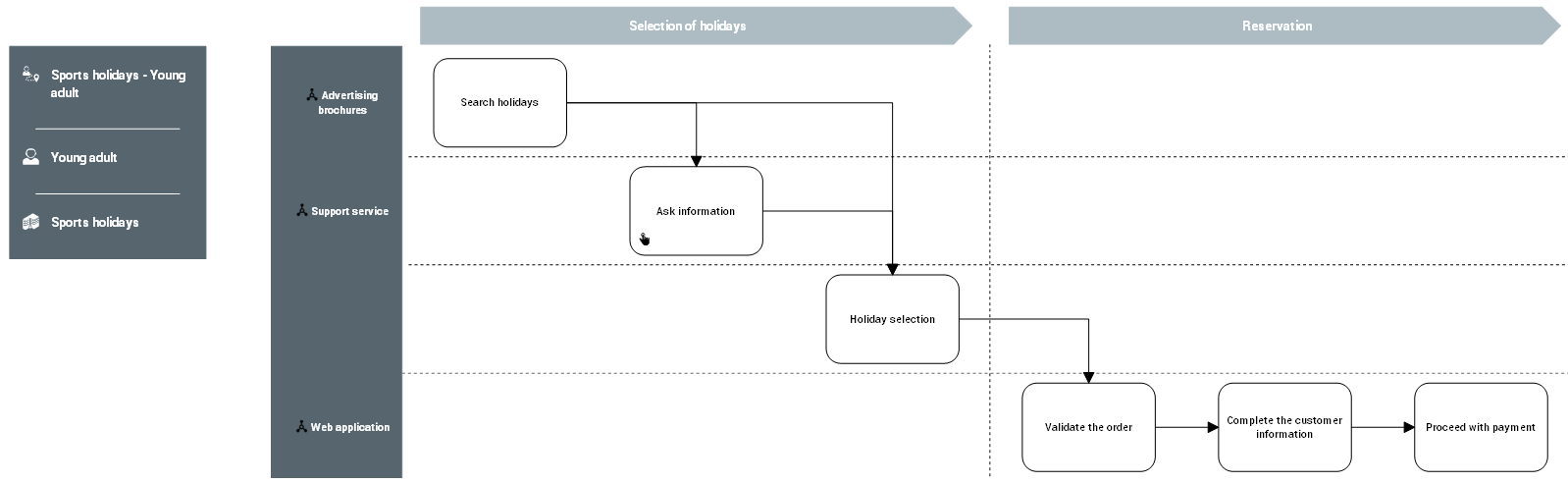
A customer journey step is the basic elementary advancement unit of a customer via a customer journey phase.In the "reservation" phase of the holiday, we can identify the following steps: "Validate the order", "Complete the customer information", "Proceed with payment".
Finally, the resources used at each step of the customer journey are represented by channels .
A channel is used to identify the enterprise resources used by a persona to achieve a step. For example, a channel can be a phone or internet connexion.In our example for selling sports holidays, the resources made available to customers are advertising brochures, web applications and a support service to answer customer questions.
To describe the steps of a customer journey, we suggest you proceed as follows:
1. Define the customer journey steps associated with each phase.
For more details, see Creating the customer journey steps in tabular input mode.2. Describe the sequences that link the steps.
For more details, see Organizing the customer journey steps in tabular input mode.3. Link the steps to the channels concerned.
For more details, see Defining the channels in a customer journey.At this stage, the diagram that you are building with HOPEX Business Process Analysis looks like the figure below.
Understanding customer expectations and painpoints
Each customer journey step can be linked to:
• One or more customer expectations.
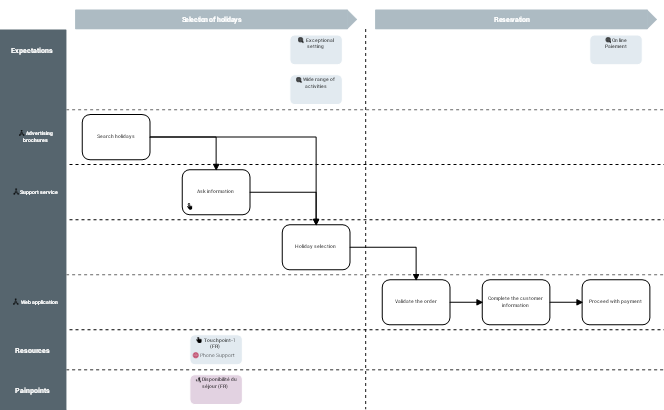
An external org-unit is an external entity that exchanges flows with the enterprise. Example: customer, supplier, government office.The expectations of young adults for a sports holiday can concern the context of the holiday or activities offered.
For more details, see Adding persona expectations to customer journey mapping.• One or more Painpoints.
A painpoint describes the difficulties encountered by a persona when carrying out a step in the customer journey.The painpoints of a group of young adults can concern the painpoint of agreeing, prices that are too high or the possibilities of accessing the vacation site.
For more details, see Defining customer painpoints.Identifying the touchpoints
The objective is to identify the organizational elements that are used during the customer journey and that could have an impact on customer satisfaction.
A touchpoint describes an interaction between a persona and an enterprise.The touchpoints between the customers and the travel agency are by telephone and by email. A support center can thus be put in place.
For more details, see Creating an involved resource in a customer journey.Each touchpoint can be linked to:
• One or more Involved Resources.
A resource is a means used to perform certain actions.An operator able to answer to questions about a specific holiday, is an Involved resource.
For more details, see Creating an involved resource in a customer journey.• One or more business opportunities.
An opportunity characterizes an improvement action for one of the composite elements of the customer journey (steps, touchpoint).To be able to offer another holiday if the holiday selected is no longer available constitutes a business opportunity.
For more details, see Defining the business opportunities of a customer journey.• One or more Painpoints.
Identifying moments of truth
A moment of truth is a decisive step for the remainder of the customer journey. Either customers believe that they cannot obtain what they are searching for under the desired conditions and they are not satisfied; Or, on the contrary, they believe that they have found what they are looking for and continue the journey.A reservation that is too late constitutes a moment of truth. The sports holiday is completed or, on the contrary, it was canceled due to low staff numbers.
For more details, see Identifying a Moment of truth.Following this last description step of your customer journey, you obtain a diagram that looks like this.